Hot Water Slab Leak and Manifold Repair in French Valley, CA
The French Valley Slab Leak Repair
A homeowner in French Valley, CA contacted Rodgers Air Conditioning & Plumbing after discovering water damage around the wall behind the water heater. Water was making its way into an adjoining closet, indicating there was a concealed plumbing leak that needed to be located and repaired.
We used thermal imaging to help trace the hot-water leak to the area between the water heater and the closet.
Once we opened the area, we found more than a single leaking pipe.
The hot and cold water manifolds coming up through the concrete had been kinked during the original installation. Both manifolds were leaking, and the damaged piping was located where the copper emerged through the slab.
Because the affected area was accessible from the closet, we were able to pull back the carpet, jackhammer a relatively small section of concrete, expose the damaged manifold piping, and make the necessary repairs without tearing up flooring throughout the home.
Finding the Slab Leak With Thermal Imaging
Slab leaks can be difficult to locate because the place where water becomes visible is not always directly above the failed pipe.
In this home, the homeowner was seeing water damage behind the water heater wall and into the neighboring closet.
We used thermal imaging to help locate the hot-water leak and narrow down the area beneath the concrete. Once we were close to the damaged piping, the sound of water leaking below the concrete also helped confirm the location.
The plumbing involved 3/4-inch copper piping in a home built in the early 2000s.
After exposing the area, we discovered that the problem involved the manifold piping where the water lines came up through the slab.
What We Found Under the Concrete
When we exposed the piping, the construction problem became clear.
Both the hot and cold water manifolds were kinked.
Instead of the copper coming cleanly through the slab with smooth bends and adequate clearance, the piping had been bent in a way that restricted the tubing. The copper was also positioned where it could make damaging contact with the concrete.
Both manifold sections were leaking.
Based on what we found after opening the slab, we believe these conditions dated back to the original construction of the home.
A kink like this does not necessarily cause an immediate failure. The plumbing can continue working for many years before the accumulated effects of poor installation, water pressure, movement, and wear finally cause the copper to leak.
That appears to have been what happened in this French Valley home.
Why a Kink in Copper Water Piping Matters
Water piping should provide as smooth and unrestricted a path as reasonably possible.
When copper tubing is kinked, the inside diameter becomes smaller at the damaged area. Water then has to accelerate and change direction as it passes through the restriction.
That can create additional turbulence instead of the smoother flow you would expect through properly installed piping.
Localized turbulence and increased water velocity can contribute to erosion of the inside of copper piping over time.
In this house, the kink was only one part of the problem.
The piping was also contacting the concrete, the hot-water piping was repeatedly expanding and contracting, and the home's water pressure was over 100 PSI.
Those conditions were all working against the life of the copper.
Hot Copper Pipe Should Not Rub Against Concrete
Hot-water piping naturally expands as it heats up and contracts again as it cools.
That movement may be small during each hot-water cycle, but it happens over and over throughout the life of the plumbing system.
When a copper hot-water line is installed against concrete, that normal expansion and contraction can cause the tubing to rub against the surrounding concrete.
Over enough time, repeated movement against a hard surface can wear on the copper.
This is one reason proper installation around slab penetrations is so important. Copper should not simply be forced through concrete in a position where it can continually rub against the structure.
In this case, we believe the combination of improper bends, contact with the concrete, and excessive water pressure significantly reduced the service life of the piping.
Why Reaming Copper Pipe After Cutting It Is Important
There is another copper-piping installation detail that homeowners rarely see but that we take seriously at Rodgers Air Conditioning & Plumbing: reaming the inside of copper tubing after making a cut.
When copper tubing is cut with a tubing cutter, the cutting wheel does more than separate the pipe. As the wheel is tightened around the tubing, it can push a small amount of copper inward at the cut.
That leaves a ridge or burr around the inside opening.
A plumber should remove that ridge before assembling the piping. That process is called reaming or deburring the copper.
Why does such a small detail matter?
The inside of a water line should be as smooth as practical. If an inward-facing ridge is left behind, the water has to travel over that obstruction every time it passes through the pipe.
The ridge slightly reduces the opening and can disturb the flow immediately downstream.
That does not mean every unreamed copper joint is going to develop a leak. Plumbing failures usually involve a combination of conditions.
But restrictions, sharp internal edges, excessive velocity, poor bends, high water pressure, and other workmanship problems can all contribute to unnecessary turbulence and wear.
This is why we do not skip the reaming process when we cut copper pipe.
It is a small step during installation, but many of the details that determine how well a plumbing system performs are hidden inside the walls or underneath the concrete after the job is complete.
The Home Had More Than 100 PSI of Water Pressure
We also tested the home's incoming water pressure.
It was over 100 PSI.
That was another condition that needed to be addressed.
Excessive water pressure places additional stress on the entire plumbing system, including pipes, valves, faucets, toilet components, appliance connections, and other plumbing fixtures.
It becomes especially concerning when there is already a restriction or weakened section of pipe.
After repairing the leaking manifold piping, we replaced the home's pressure regulator and adjusted the water pressure to approximately 70 PSI.
We did not want to repair the leak and then leave the home's plumbing operating under the same excessive pressure.
Spot Repair or Reroute?
Before making the repair, we discussed two possible approaches with the homeowner.
One option was to make a localized spot repair by opening the slab at the damaged manifold and repairing the piping in place.
The other option was to reroute the affected water line, avoiding continued reliance on the existing under-slab portion of that line.
Both approaches have advantages and disadvantages.
Spot Repair
The primary advantage of the spot repair on this particular job was that we knew where the leak was and it was located in an area where the concrete could be accessed from the closet.
We could pull back the carpet, open a relatively small section of the slab, expose the problem, make the repair, patch the concrete, and restore the closet.
This meant less demolition, less wall repair, and a lower initial cost than rerouting the entire line.
The limitation of a spot repair is that we are repairing the area we can see.
The rest of the original copper piping remains in place.
Because this home was built in the early 2000s and we had already found significant construction defects in the manifold area, there is no way to see every inch of copper underneath the slab and guarantee that another installation problem does not exist elsewhere.
We explained that clearly to the homeowner.
Rerouting the Water Line
A reroute would take the old under-slab section out of service and replace it with a new line run through an accessible path.
The benefit is that the homeowner is no longer relying on that particular original under-slab water line.
The tradeoff is that rerouting normally requires opening additional sections of walls or ceilings so a new pipe can be run from its source to its destination.
That makes the job more involved and generally more expensive.
We explained the advantages and disadvantages of both options so the homeowner could make an informed choice rather than simply being told there was only one way to repair the leak.
For this project, the homeowner chose the spot repair because of the accessibility of the damaged manifold, the reduced amount of demolition, the lower cost, and the speed with which the repair could be completed.
Opening the Closet Floor to Reach the Manifold
Because the damaged piping was located beneath the closet floor, we pulled back the carpet in the closet to access the slab.
We then jackhammered a small section of concrete directly over the leaking manifold area.
Opening the slab allowed us to fully expose the damaged piping and make the repair in the correct location.
Rebuilding the Damaged Copper Manifold
We removed the damaged and kinked copper and rebuilt the affected manifold piping with new copper.
Approximately one foot of damaged piping was replaced in the repair area.
An important detail of this repair is the way the copper connections were made.
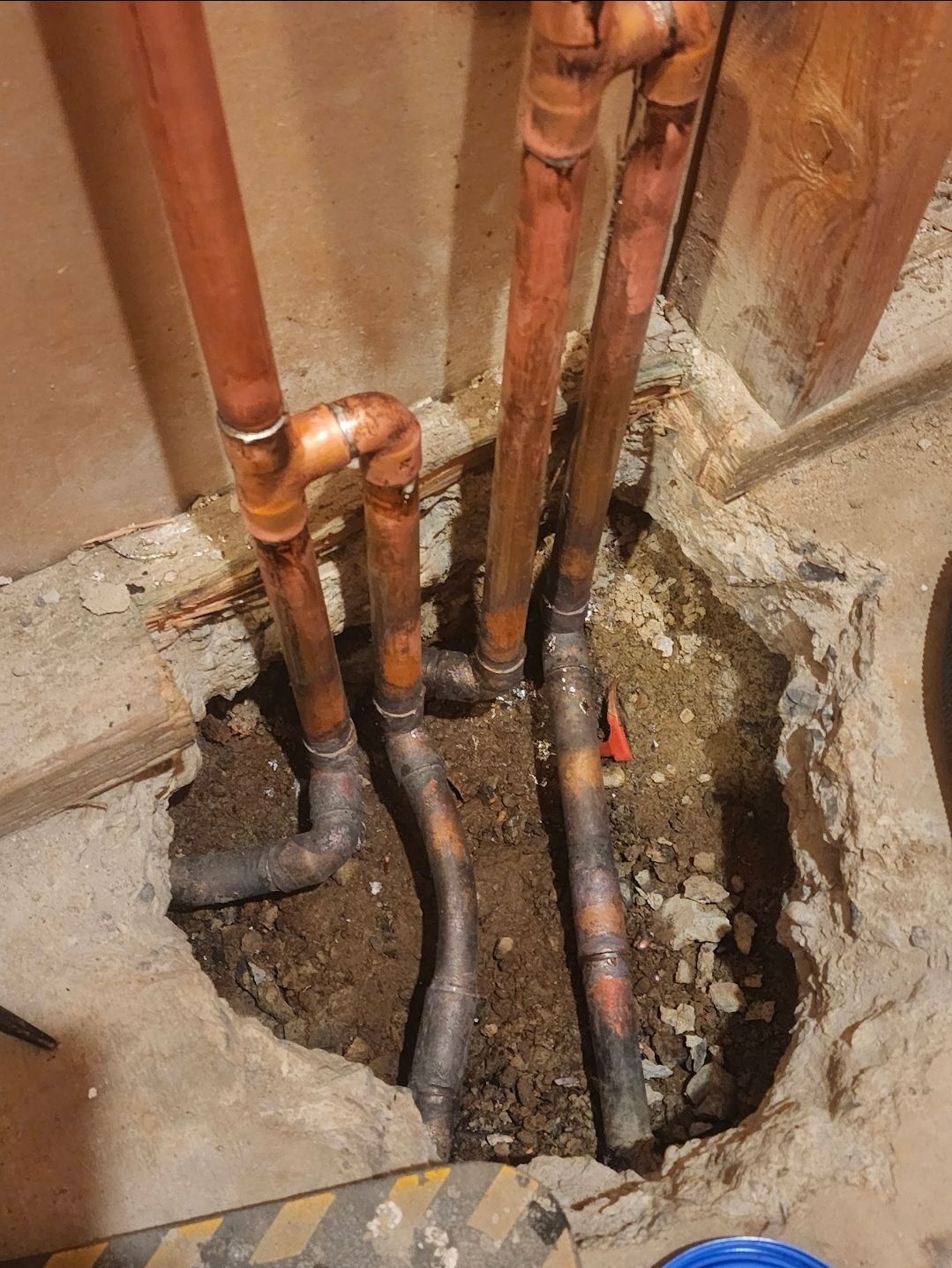
The joints located below the concrete were brazed rather than soft-soldered. For the accessible connections above the slab, we used soldered copper joints.
The completed repair photo shows the plumbing before the concrete was patched. In the open slab, the brazed connections can be seen below the concrete level, while the soldered connections are above the slab.
Pressure Testing Before Closing the Concrete
We did not patch the slab immediately after making the copper connections.
First, we restored water pressure and performed a static pressure test, also called a standing pressure test.
With the plumbing system pressurized, we shut off the incoming water supply and monitored the system to make sure it held pressure.
This allowed us to verify the repair before covering the piping back up with concrete.
Once we confirmed that the plumbing was holding pressure properly, we patched the opened section of slab.
The closet could then be restored, and we connected the homeowner with a drywall contractor who repaired and repainted the affected wall.
Fixing the Cause Instead of Only Fixing the Leak
One of the most important parts of this job was looking beyond the hole in the pipe.
The active leaks had to be repaired, but we also found several conditions that helped explain why the piping failed:
The hot and cold manifolds were kinked. The copper was making damaging contact with the concrete. The hot-water piping was repeatedly expanding and contracting against that area. The home's incoming water pressure exceeded 100 PSI.
We repaired the damaged piping and replaced the pressure regulator so we could reduce the home's water pressure to approximately 70 PSI.
Correcting a contributing condition such as excessive pressure is an important part of making a complete plumbing repair.
What This French Valley Slab Leak Can Teach Homeowners
This job illustrates why the quality of the original plumbing installation matters.
The homeowner had been living with copper piping that had been improperly kinked since the house was constructed.
The plumbing still operated for years.
That can make an installation problem easy to overlook. A construction defect does not always cause a leak immediately.
Instead, the pipe may slowly deteriorate until years of pressure, water flow, heat cycles, movement, and physical wear finally cause it to fail.
In this French Valley home, opening the slab allowed us to see exactly what had happened and repair the affected manifold correctly.
It also gave us an opportunity to identify and correct the home's excessive water pressure.
Signs You May Have a Hot Water Slab Leak
Some slab leaks are dramatic, but others begin with relatively subtle symptoms.
Homeowners should consider having a plumbing leak investigated if they notice:
Water damage appearing at the bottom of a wall; wet carpet or flooring without an obvious source; a warm or unusually hot area of flooring; the sound of running water when plumbing fixtures are off; a water meter that continues moving when no water is intentionally being used; an unexplained increase in the water bill; or water appearing near a water heater even though the water heater itself does not appear to be leaking.
Finding water around a water heater can be especially misleading.
The water heater may be the first thing a homeowner suspects, but the actual problem can be a hot- or cold-water line underneath the slab nearby.
That is why locating the source of the water before beginning a repair is so important.
Slab Leak Repair in French Valley, CA
Rodgers Air Conditioning & Plumbing provides slab leak detection and slab leak repair for homeowners in French Valley and the surrounding communities.
When we locate a slab leak, our job is not simply to tell the homeowner that a pipe is leaking.
We want to understand where it failed, what may have contributed to the failure, and what repair options are available.
Depending on the location and condition of the plumbing, those options may include opening the slab for a localized repair or rerouting the affected water line.
We explain the advantages and limitations of the available options so the homeowner can make an informed decision about their home.
For this French Valley homeowner, accessing the manifold through the closet allowed us to repair the damaged hot and cold copper piping, patch the concrete, correct the home's excessive water pressure, and avoid a much larger amount of demolition.